Dripper fit, paper shapes & care
Measure cone, flat-floor and wave seats; match five paper constructions and build a stable pour-over setup.
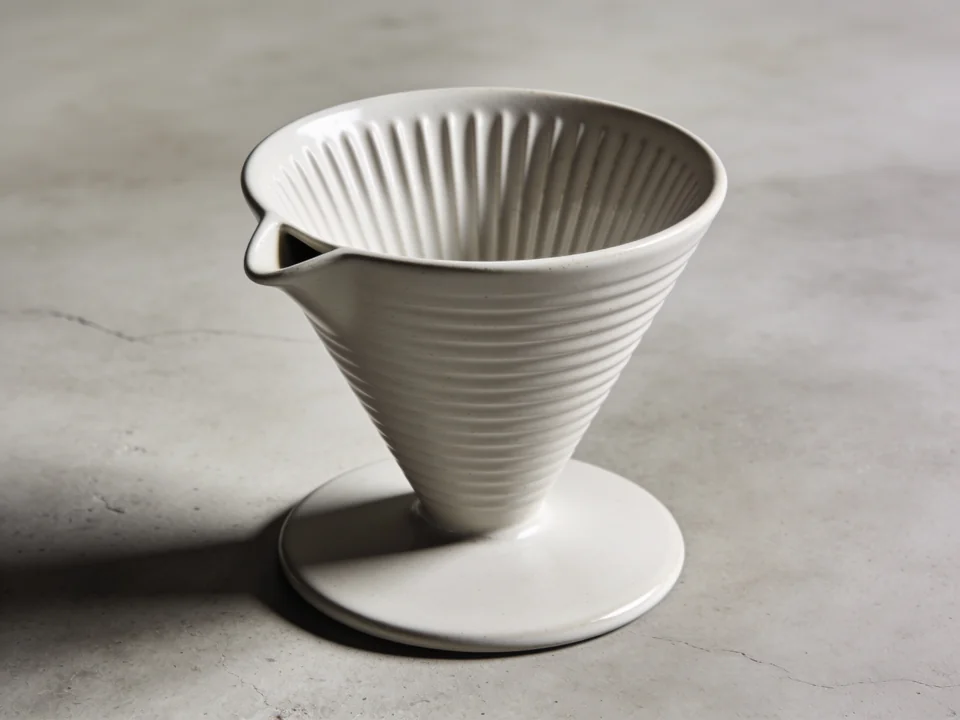
Start with the empty support
Measure equipment only when it is cool, empty and clean. For a mug or server, measure the level rim where the dripper actually rests. Compare that measurement with the product’s supported vessel-rim range, not just its body width. Put the dry dripper in place and check for rocking or a narrow contact point before adding anything hot.
For paper fit, identify the seat first: pointed cone, wedge, round cup, flat disc or folded-sheet support. Measure the bottom shape and usable height. The rim should remain above the intended grounds and water level. Paper that hangs through an outlet, blocks an air channel or buckles against the floor is not a correct fit, even if its upper edge appears to match.
Cone, flat floor and wave are not synonyms
The d01 ceramic, d02 glass and d05 folding wire drippers use p01 pointed cones. Fold the seam flat, open the paper and center the tip without crushing it into the outlet. On the open wire frame, confirm that the paper remains supported between the wires; a frame does not function as a paperless metal mesh.
The d03 steel basket takes p04, a 60 mm flat disc. It lines only the perforated floor; keep grounds over that area rather than against an unlined sidewall. The d04 porcelain wave dripper uses p03 with a 50 mm base and 55 mm pleated wall. Keep the cup base flat and pleats open; do not push the paper into the three drains.
Two formats for equipment outside this range
The p02 trapezoid paper has two tapered panels, a 45 mm bottom seam and a 100 mm height. It needs a wedge-shaped brewer accepting those measurements. Fold its bottom and side seams before opening it. No dripper sold here is a confirmed pairing, and a pointed cone is not a substitute for the wedge seat.
The p05 square sheet measures 200 by 200 mm unfolded. Separate one panel from the other three to make its supported cone and orient the thicker side at the receiving brewer’s air channel. Use it only in a brewer intended for that folded-sheet construction. Do not trim it to fit our cone drippers or assume that every square-paper brewer takes this size.
A starting brew setup, not an outcome claim
Set a clean vessel on a level heat-resistant surface. Fit one compatible paper, rinse gently if you prefer and discard the rinse water. Place the vessel and dripper on a scale if you use one, and check their stability together. Weigh 15 g of coffee and prepare 250 g of water as an initial ratio; coffee and brewing tools are not included with these accessories.
Pour a small amount to wet the grounds, then add the remaining water gradually without filling to the paper rim. Keep the outlet unobstructed. Grind, coffee dose, pouring and paper construction can all change drainage, so this guide does not promise a brew time or flavor. If water backs up, stop pouring and allow the assembly to cool before inspecting it. Do not lift a hot full dripper to clear a blockage.
When the setup does not sit right
If a cone tip folds inward, remove the dry paper and reopen it; compare its seam height and angle with the support. If wave walls collapse, separate one paper carefully and reseat the flat base without flattening the pleats. If a disc curls or leaves holes uncovered, confirm that it is the listed 60 mm format for d03 instead of stacking a second disc.
If the dripper rocks, change to a vessel within the listed rim range rather than balancing it on an improvised spacer. Fully unfold d05 before the paper is inserted and leave its arms untouched during brewing. A crack, chip, loose hinge or damaged support is a reason not to use the item. Contact us with the product ID and a description; photographs of cool, empty equipment are enough.
Clean the support, protect the paper
Cool every dripper before removing grounds and cleaning. Hand-wash ceramic and porcelain gently, keeping drain openings clear. For glass, remove the silicone ring and avoid hard tools or abrupt temperature changes. For stainless steel, brush perforations or hinges softly, rinse away soap and dry. Do not use steel wool, strong chlorine cleaners or unlisted stove or microwave applications.
Keep paper dry and away from cooking odors. Store wave papers nested without crushing their walls; keep discs flat and folded sheets protected at the corners. Every paper in this range is single-use. Disposal or local compost acceptance depends on the used material and your local service; we do not claim that all paper filters are accepted everywhere.
6145 S. Ivy St.,Centennial,CO,80111,United States
Company ID 20151160349
[email protected]
+1 (720) 749-2752